Figure 2: HR involvement in decisions around AI and automation investment and implementation
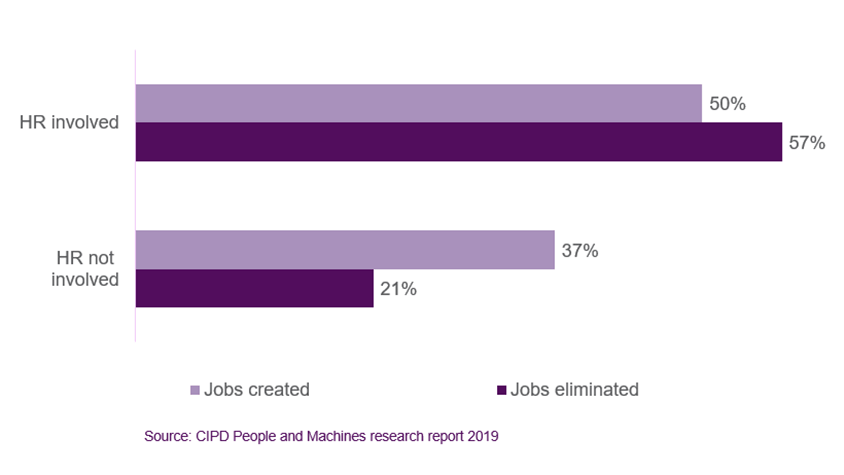
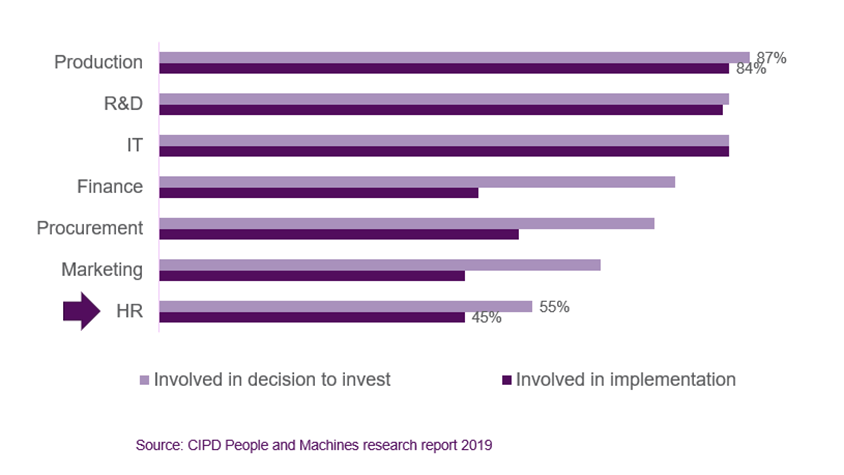
Figure 3: Departments involved in decision to invest and implementation of AI and automation
People professionals have a responsibility to address the many nuances associated with digital transformation and its impact on people. How can the profession be more involved in shaping this change?
Conducting workforce planning and skills gap analysis
There is, of course, more to the employee lifecycle than being recruited to or leaving a role. Employees need to be onboarded, developed and motivated to perform to their best. People professionals can take a more proactive role in workforce planning and skills gap analysis if they are included early in decisions involving investment in technology. For example, by:
- considering how internal and external trends might impact the organisation’s future workforce needs and skills gaps
- working with leaders to identify strategies to meet the organisation’s future workforce needs
- facilitating early conversations with employees who might be affected by new technology.
Employees who are consulted are more likely to agree with the business benefits of technology and feel more confident to raise concerns, according to the CIPD Workplace technology: employee experience report.
Considering job redesign, incentives and other ways to improve job quality
When technology impacts work, people professionals should consider how the CIPD’s seven dimensions of job quality can be leveraged to improve overall job quality. The seven dimensions include:
- pay and benefits
- employment contracts
- work-life balance
- job design and nature of work
- relationships at work
- employee voice
- health and wellbeing
Implemented correctly, technology can improve both employee performance and job quality. Approached the wrong way, it can have the opposite effect.
Explore with managers and affected employees how intelligent process automation can redesign, and potentially safeguard, their jobs. If some of the more tedious parts of a job can be automated, this can help give back time to focus on higher value tasks. Technology can help the people profession conduct this process efficiently to gain insight on employees’ current skills. For example, by using a talent management system if information on skills across the organisation is regularly updated, or using LinkedIn or similar social media platforms.
Consider ways to incentivise the workforce to use technology to automate their work to benefit themselves and the organisation. For example, employees who have automated a significant amount of work might be rewarded with a four-day week, attend expensive training, or receive bonuses. These employees could become automation internal coaches or even sell their consultancy services to other organisations. Sumitomo Mitsui Banking Corporation (SMBC) did the latter after enterprise-wide automation eliminated 800 full-time roles. Headcount did not fall. Instead SMBC retrained and transferred displaced employees to its new subsidiary SMBC Value Creation. The subsidiary offers intelligent process automation expertise to other financial institutions.
Intelligent Automation authors Bornet, Barkin and Wirtz believe that incentivising automation could avoid moral dilemmas such as the one highlighted by this viral Stack Exchange post: ‘Is it unethical for me not to tell my employer I’ve automated my job?’. After 18 months in the role, the employee had automated their work to the point where they received full-time pay for work that now took only one or two hours a week.
Providing outplacement services, if necessary, working with government and other agencies
As noted in Figure 1, technology can eliminate jobs. Sometimes there are no alternative roles for employees in the organisation. In these situations, the people profession can organise outplacement services to give redundant employees the emotional and practical support they need to find jobs elsewhere.
In Kenya, Unilever’s tea plantations identified that mechanisation would impact low-skilled employees and families who depend on their livelihoods. Partnering with local government and non-governmental agencies, reskilling initiatives were deployed as well as a funding programme for employees to become entrepreneurs. Over 2,000 redundant employees are consequently in alternative employment. That’s over 10,000 livelihoods sustained. Trade unions and social partners said the initiatives have had a positive social impact in the community.
Participating in the debate on the future of work
The impact of technology on the future of work is too important for organisations to deal with internally. As we’ve seen in the Unilever example, governments and other agencies must also be involved when technology impacts the livelihoods of thousands of people. Otherwise, there could be social unrest. People professionals can draw on first-hand experiences from the ground to shape debates on the future work.
Skills, job design and wealth sharing are often key features of debate around the future of work:
- What skills do employees need for the future and what support do they need to gain those skills?
- How can jobs be designed to make working lives better?
- How do we share the financial gains of technology fairly to mitigate the risk of low-paid or redundant employees plunging into poverty?
Addressing these questions will involve refocusing education and societal values:
- If all mental and physical tasks can eventually be done more cheaply by machines, then shouldn’t education focus more on soft skills that are difficult to automate like empathy, creativity, and imagination?
- How do we use technology to create a people-centred jobs market that focuses more on enabling social and environmental change that benefits everyone?
Technology is changing the nature of work as we know it. But what happens in the future will depend on how governments, organisations and employees around the world respond. People professionals should play a key role in this response.
Get involved and help us understand the future of the profession