Gaining understanding from action research
The CIPD have previously explored examples of how HR is leveraging technology, which all serves as a reminder of the need to balance driving operational efficiency with what matters to the people who will be using the technology. Not addressing this balance between people and technology could lead to unrealistic expectations, failed projects and disappointment.
However, guides and case studies can only do so much to inspire action and sometimes a bit of greater reassurance is what’s needed for organisations to take a step towards a truly people-centred approach to AI. The CIPD was able to do this when taking part in the InnovateUK BridgeAI programme, funded by the UK Government, to help bridge the gap between AI innovation and responsible implementation at work.
As part of the programme, seven organisations from CIPD’s member network took part in action research with the Institute for the Future of Work (IFOW). A key feature of the action research was for participants to reflect and/or act on learnings during adoption alongside our research partner, IFOW.
Using the ‘6Rs’ to support a people-centred approach to AI
For this process, IFOW worked with the CIPD’s contacts to form a representative working group in each organisation (eg comprising HR, legal, IT and key AI users). Where one already existed, IFOW tapped into this network and, if needed, extended the membership so that other key voices were heard.
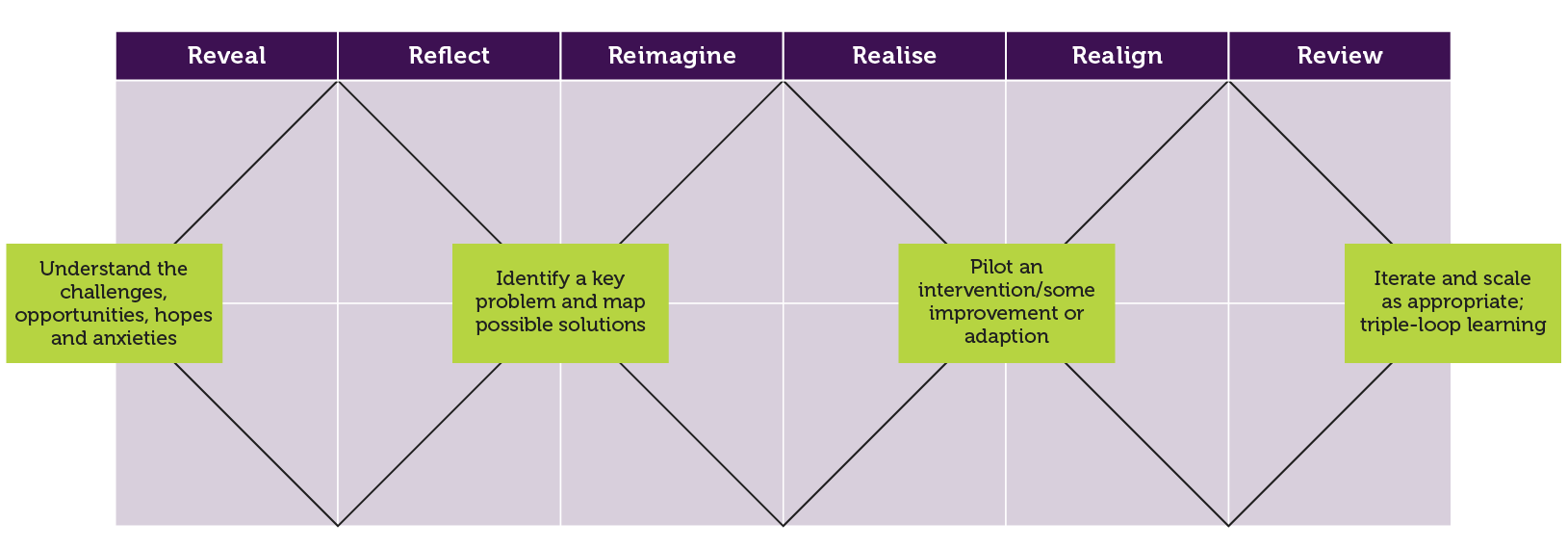
To support the organisations in taking a people-centred approach throughout the action research stages, IFOW used their 6Rs framework* (Figure 1). The 6Rs show six key actions organisations should take when implementing AI:
- Reveal the state of play and context for AI implementation. This stage involves collecting documents (eg strategy, plans, structure) and speaking with key people making the decisions around, implementing or using the AI-enabled solution. In some organisations IFOW ran a survey to gather employee views.
- Reflect on the challenges for integrating AI responsibly and effectively. Here, IFOW shared an in-depth report they created based on information gathered from the Reveal stage for the working group to reflect on.
- Reimagine practical solutions for the identified challenges with the people involved. To help this process IFOW facilitated a workshop to do this, which they co-designed with the organisation’s working group.
- Realise the practical solutions that are most impactful and feasible. IFOW summarised and shared outcomes from the workshop and co-developed possible interventions with relevant people.
- Realign to deliver and embed these changes. IFOW supported the working group to prioritise the solutions and draft an action plan.
- Review outcomes and impacts and set up ongoing monitoring. This included IFOW working with relevant people to analyse the impact of their actions.
Figure 1: Key steps in IFOW’s 6Rs framework
Learning and takeaways around the 6Rs framework
The key lesson that was learned in implementing the 6Rs framework is that it was those within an organisation taking bold and proactive steps that moved their organisations towards a people-centred approach to AI. The 6Rs framework in the action research mainly served as a reminder to consider the people and work collaboratively across functions to refine next steps, with IFOW providing input along the way.
Moreover, periodically slowing down to reflect together was a valuable sense-making process for some employees, thereby making the process more inclusive. It helped them build a shared understanding and co-develop solutions to address challenges.
Some organisational structures were more challenging to navigate than others. Fragmented governance and a technology-centred approach to AI held back progress on exploring what a particular AI use means in terms of job design and organisation design. Getting the best-suited people from different teams and levels of seniority to engage was difficult in a backdrop of wider organisational change. Furthermore, the tight project timescales didn’t always align with the organisation’s plans or preferable approaches with the organisations.
These organisational and project constraints meant that small steps counted as considerable progress. Of the seven organisations that took part in the action research, two completed all six stages. The other five got up to between stages two to four of the 6Rs framework (2Rs were completed by two of the five organisations, 3Rs were completed by another two of the organisations and the remaining two organisations of the five completed 4Rs). IFOW also secured access to an eighth organisation to observe and write a case study about their approach to AI (but did not undertake action research with the organisation).
The bold and proactive steps seen could be described in terms of employees' willingness, capability and capacity for effective and responsible AI use (factors for AI adoption set out in another piece of research commissioned by the UK Government):
In continuing this work, the CIPD and IFOW will share examples of these behaviours from employees along with key takeaways for people professionals at a later date. The CIPD and IFOW would like to thank everyone involved for the time they gave in this research.
*This framework is part of ongoing doctoral work by Anna Thomas MBE