
Policy and insights
The latest views and insights from our experts on the world of work

James Cockett, Senior Labour Market Economist, explores how UK organisations are adopting generative AI, where they are on their AI maturity journey, and how productivity pressures are shaping both uptake and concerns.
Generative AI has rapidly moved from experimental novelty to a key workplace asset. In our Autumn 2025 Labour Market Outlook, we found the use of AI across UK workplaces is widespread. This article focuses on generative AI* at work: how commonly it is permitted, what steps employers have taken in implementing generative AI and what they see as the benefits and drawbacks.
Many UK organisations (61%) now allow employees to use generative AI to assist them in work related tasks. One in ten employers (10%) are planning to allow their employees to use generative AI, but they have not implemented this yet. However, in one in four organisations in the UK employees are not allowed to use generative AI, and there are no plans to do so (25%).
Sector and organisation size make a difference. Public sector employers are much more likely to have enabled the use of generative AI than private or third sector organisations (73% versus 57% and 62% respectively). In the private sector, large employers - particularly those with more than 500 staff - are more open to using AI than SMEs, suggesting that having more resources to invest makes adoption easier. In the public sector, the drive for efficiency weighing heavy on our less-than-optimal public services is likely to be driving faster uptake.
Industry differences are also striking. Employees in predominantly desk-based sectors - such as professional services, education and IT - are far more likely to be allowed to use generative AI than those in manual or operational industries like construction, retail and transport.
Researchers from the Massachusetts Institute of Technology (MIT) have identified four stages of AI maturity within organisations, from early experimentation to becoming future AI ready. At the time of their research, they found that very few organisations had reached stage 4, with the majority split across the other three stages. Our data shows that a significant number of UK employers remain outside the maturity model by not allowing the use of generative AI at all.
Figure 1: The MIT CISR Enterprise AI Maturity Model
|
AI Stage Attributes |
Stage 1: Experiment and Prepare |
Stage 2: Build Pilots and Capabilities |
Stage 3: Develop AI Ways of Working |
Stage 4: Become AI Future Ready |
We asked employers what steps they have taken to implement generative AI over the past 12 months, focusing on activities associated with the early stages of adoption.
One of the first steps is developing formal policies and guidance for staff. This has doubled in prevalence in two years: 31% of employers have reported they have now worked on a generative AI policy in the past 12 months, compared with 16% previously. At the early experiment and prepare stage it is common for employers to form an AI working group. Our survey finds one in four (25%) employers have done so in the last 12 months.
As organisations progress, many start to identify activities or business use cases where generative AI can be applied (recorded by 36% of employers) and assess the level of AI expertise or skills in the organisation (25%).
Organisations who are more mature in their adoption are more likely to have upskilled employees with AI expertise (23%), but, as well as upskilling, 18% of organisations have recruited people with AI expertise, despite them being in short supply. Recent research from the University of Oxford exploring vacancy trends since 2018 showed AI skills, not necessarily qualifications, are soaring in demand, with candidates with AI skills commanding a wage premium of 23%, in part due to their scarcity.
Those organisations further on in their AI maturity have provided training and support to help employees use generative AI in their work (35%) and introduced platforms for staff which use generative AI, such as Copilot (43%). These activities signal a shift from isolated experiments to embedding generative AI in new ways of working.
The need to increase productivity/efficiency is the standout reason organisations (41%) give for adopting generative AI in the last 12 months. This comes against the backdrop of the Office for Budget Responsibility’s productivity outlook. They expect AI to begin having a positive effect on productivity growth within the next five years, but highlight there is significant uncertainty around both the size and timing of this effect (as outlined below). They suggest that AI will make a smaller contribution to productivity growth over the next five years than the ICT revolution did before the financial crisis.
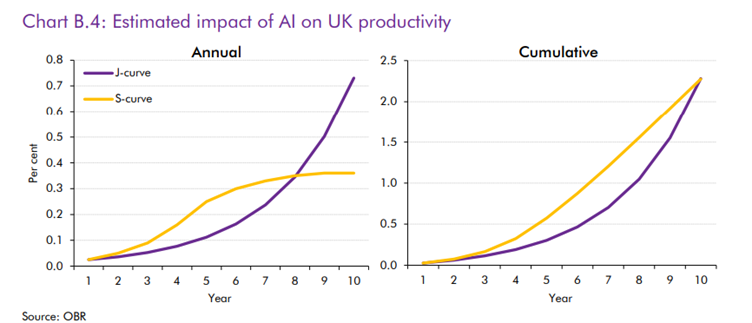
Despite this, there is early trial evidence from the UK Civil Service which found that using generative AI to assist with everyday tasks saved civil servants an average of 26 minutes per day. This adds up to nearly 2 weeks of time saved per year per person. The need to innovate is also identified by employers (18%) as a driver for adoption. And an OECD research summary found evidence that generative AI can help people produce more novel ideas, and supports the design and development of new products, services, or technologies.
As generative AI becomes more widespread organisations are more aware of the downsides. Whilst two years ago a quarter of organisations were unsure about the drawbacks, this figure now stands at just one in ten employers (11%). Instead, privacy and security concerns are more evident as reported by half of employers (48%), up from 36% in Autumn 2023. And privacy concerns rise among employers who have not yet implemented generative AI (54%) and those who do not plan to (64%).
But rising concerns are not a sign of increased risk. They happen because of organisational maturity, and mark the shift from experimentation to scalable use that will underpin sustained, rather than temporary, productivity gains.
While early adopters in the UK are embedding new tools and ways of working, others remain cautious or excluded altogether. Productivity pressures look to be the primary driver of uptake, and early evidence suggests meaningful time savings are possible. However, these gains are unlikely to be realised without investment in skills, governance and organisational capability.
For people professionals, the implications are clear. As custodians of sensitive data and enablers of workforce capability, they have a central role to play in shaping responsible, effective AI use. By putting the right principles, guardrails and training in place now, organisations are more likely to move beyond experimentation and achieve sustained productivity gains over the longer term.

The latest views and insights from our experts on the world of work

Keep up-to-date on the latest research and current practices with our reports, factsheets and guides

Read all the latest updates about our work to lead and support the people profession to champion better work and working lives