To fully understand the gender pay gap, we need to think about it in three different ways:
- As a measure of labour market disadvantage – for example, throughout the economy, women are concentrated in lower-paid jobs.
- As a measure of workplace disadvantage – for example, women in your organisation are concentrated in lower-paid jobs; this is where the government wants you to act. Taking steps to reduce the gap at workplace level will help narrow the gap at national level.
- As a measure of the difference between the individual earnings of a man and a woman – a difference doesn’t automatically mean that the woman is missing out on equal pay. To be entitled to equal pay, a woman must be employed by the same employer, on the same terms and conditions, and the work that she does has to be equal to that being done by her male colleague. And even then, there may be an acceptable reason for the pay difference, such as location. However, it’s also important not to lose sight of the fact that unequal pay may be contributing to the gender pay gap.
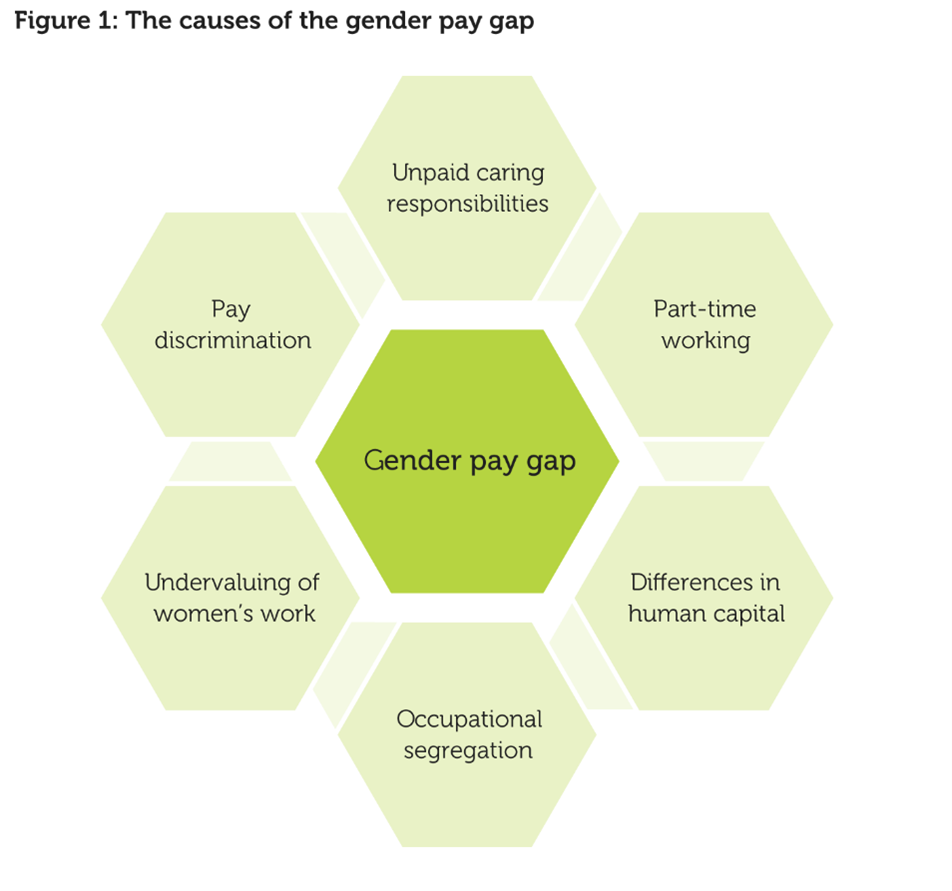
Gender pay gaps are the outcome of economic, cultural, societal and educational factors. Some argue that they reflect personal choice but, although the decision to seek paid employment may be an individual choice, that choice is strongly influenced by matters outside of the individual’s control, such as the availability and affordability of childcare, and it is still the case that the choices available to women are more constrained than those available to men. The key influences on the gender pay gap are:
- unpaid caring responsbilities
- part-time working
- differences in human capital
- occupational segregation
- undervaluing of women’s work
- pay discrimination.
Four of these matters are explored in-depth below.
Unpaid caring responsibilities
The cost of childcare has been identified as a particular problem that affects women’s participation in the labour market. A 2017 report from Working Families found that childcare costs account for a significant proportion of family expenditure and that the high cost of childcare has a great influence on whether parents, particularly mothers, choose to either give up work or reduce their working hours. And, in so far as the care of adults is concerned, women are more likely than men to be carers.
Women as unpaid carers: A survey carried out by Carers UK in 2022 found that 80% of carers are female.
Between 2000 and 2015, time spent caring for adults by people aged over 50 has increased, but there is concern that there may not be enough unpaid carers to meet future demand. Factors such as increasing female employment, fewer children and higher divorce rates among men over 60 years may affect the future availability of children to provide unpaid care for their elderly parents. In 2015/16, an estimated 345,000 unpaid carers aged 16-64 in England, predominantly women, left employment to provide care.
In 2022, 600 people a day, on average, left work to take on caring responsibilities, and 75% of carers still in employment worry about juggling work and care.
Occupational segregation
Despite half a century of equalities legislation, the UK labour market remains highly segregated, with men dominating some types of job and women others; many women are concentrated in the ‘five Cs’ of caring, cleaning, catering, clerical and cashiering, all of which tend to be lower paid. In terms of the gender pay gap, the problem with occupational segregation is not that men and women are doing different types of work, but that segregation is associated with these jobs being valued differently. The introduction of the National Minimum Wage and the National Living Wage provides a wage floor for the lowest-paid jobs but does nothing to challenge any underlying undervaluation of the work.
In terms of gender pay gap reporting, a lot of attention has been paid to vertical segregation – jobs in the higher echelons of an organisation being dominated by men – but horizontal segregation also contributes to the gender pay gap. Horizontal segregation occurs lower down the hierarchy and manifests as men and women doing distinctly different types of work, with the ‘male’ jobs being paid more than the ‘female’ jobs. When the reverse is true – the ‘female’ jobs being paid more than the ‘male’ jobs – a negative gender pay gap may arise. In the first two years of gender pay gap reporting, some employers have been paying increasing attention to the impact of horizontal segregation and are looking to find ways of tackling it.
Pay discrimination
In terms of the gender pay gap’s contribution to actual inequalities in pay, horizontal occupational segregation presents a high risk of equal pay claims, as does a high mean bonus gap. We look at this later in What your measures tell you, but it would be sensible to take account of the risk of equal pay claims being brought. In 2017/18, the Employment Tribunal received 35,558 equal pay claims. In 2018/19 the figure fell to 26,860, but as the reports only provide the headline figures for the number of cases filed, it is not possible to form a view as to why there has been a substantial drop.
Part-time working
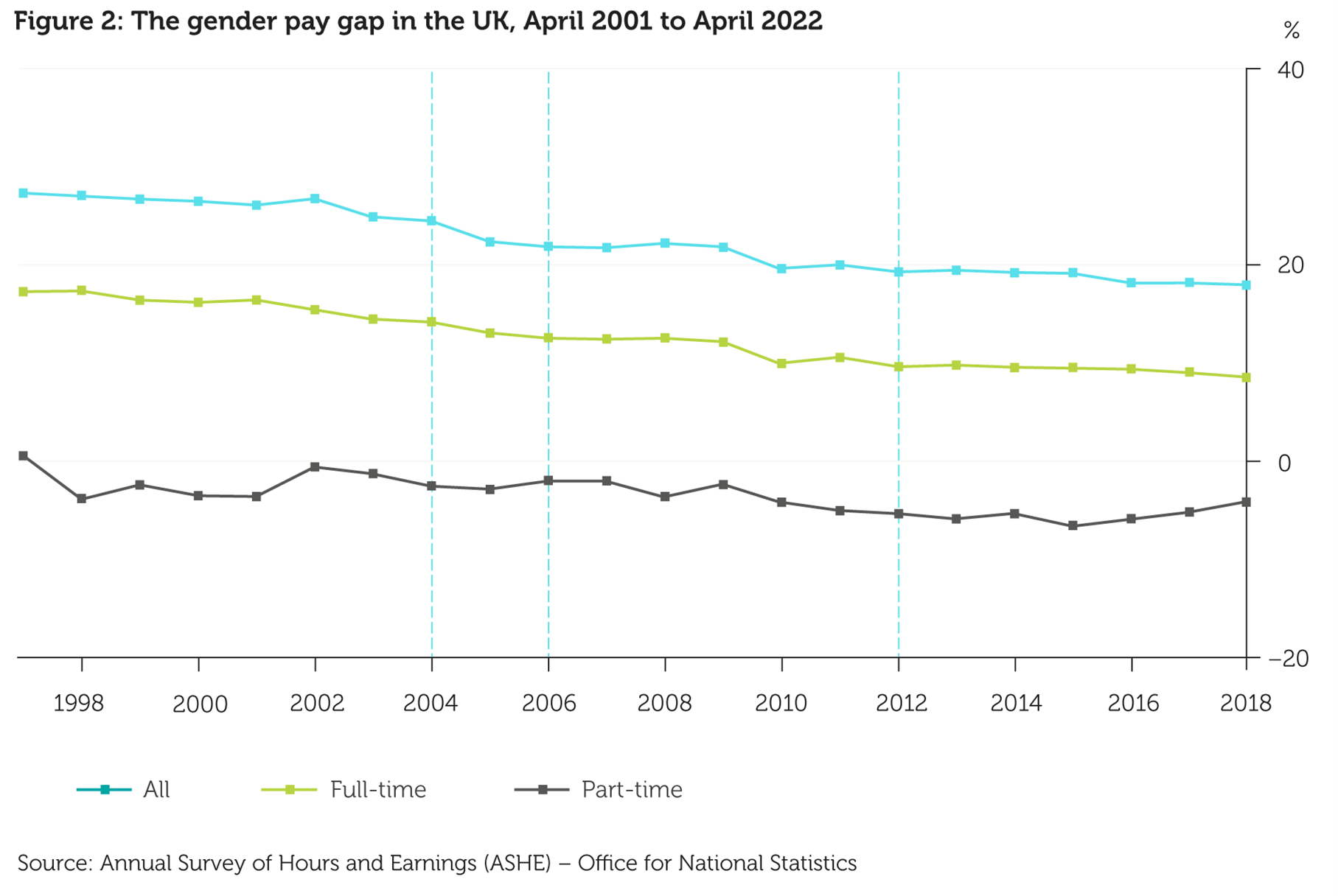
Looking only at part-time employees, we see a negative gender pay gap, with median pay for part-time employees being higher for women than for men. However, hourly rates of pay for part-time work tend to be lower than for full-time work and, with such a high percentage of women working part-time, their low hourly rates of pay mean that the gender pay gap for all employees is greater than that for full-time employees alone. Seventy-one per cent of part-time workers are women; 38% of women work part-time, compared with 14% of men. And whereas men tend to work part-time at the beginning and end of their working lives, women do so in their middle years.